
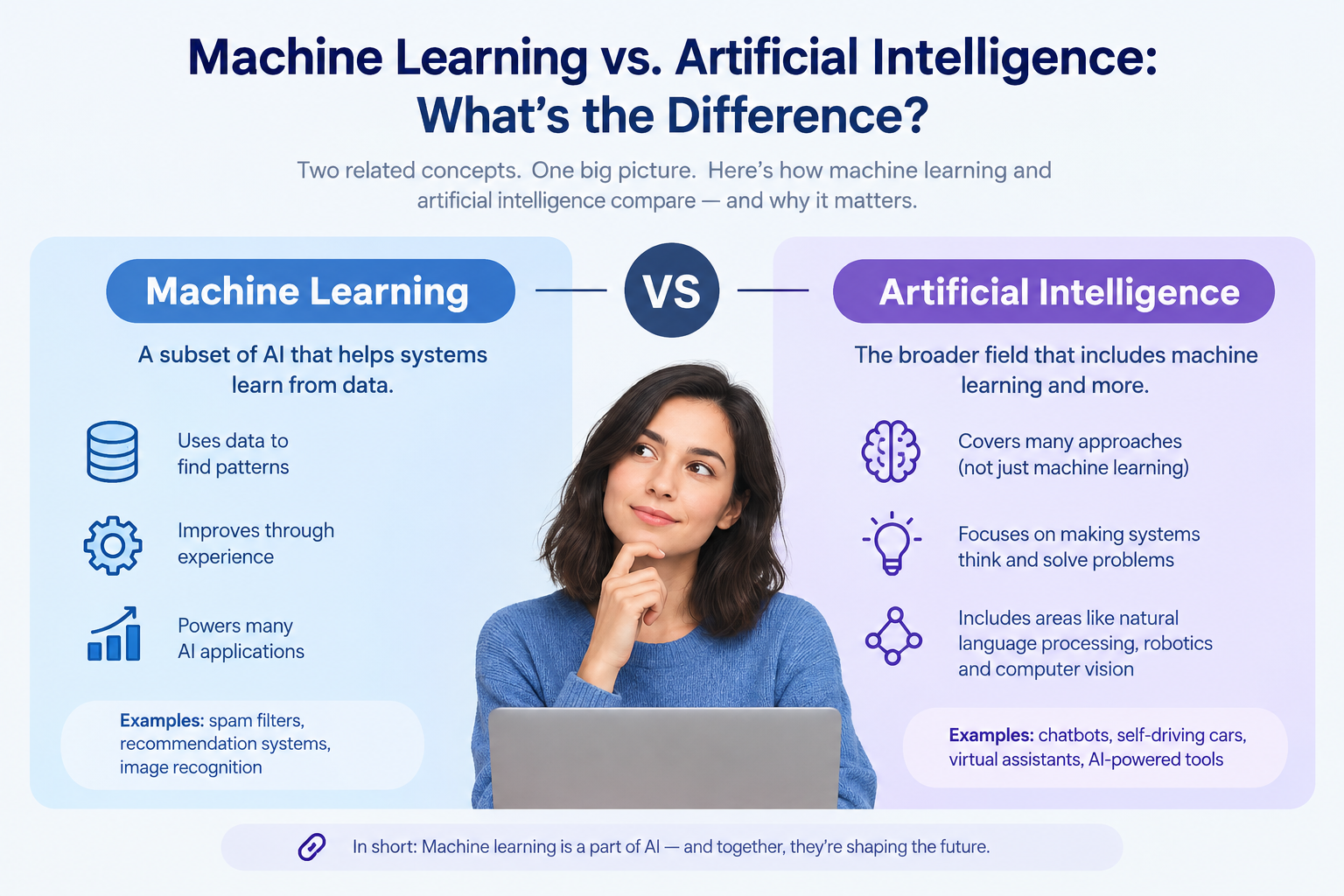
If you have spent any time reading about technology, you have probably seen the terms artificial intelligence (AI) and machine learning (ML) used almost interchangeably.
That can be confusing.
Is machine learning the same thing as artificial intelligence? Is one more advanced than the other? And where do technologies like ChatGPT, recommendation systems, and self-driving cars fit into the picture?
The short answer is simple:
Machine learning is a part of artificial intelligence, not a completely separate technology.
Think of artificial intelligence as the larger field. Machine learning is one of the most important approaches used to build AI systems.
But there is more to the story. Understanding the difference becomes much easier once you see how the two concepts fit together.
What Is Artificial Intelligence?
Artificial intelligence is the broader idea of creating computer systems that can perform tasks that normally require some form of human intelligence.
Those tasks can include:
- Understanding language
- Recognizing images
- Solving problems
- Making predictions
- Identifying patterns
- Planning actions
- Making decisions
- Generating text, images, audio, or other content
You probably interact with AI more often than you realize.
When your phone recognizes your face, when a streaming service recommends a movie, or when a virtual assistant responds to a question, AI may be involved.
Our beginner’s guide to artificial intelligence explains the broader concept of AI and how it has developed.
The important thing to remember is that AI is the goal or broader field, while machine learning is one of the methods used to achieve that goal.
So, What Is Machine Learning?
Machine learning is a branch of artificial intelligence that allows computers to learn patterns from data and use those patterns to make predictions or decisions.
Instead of programming every possible rule into a computer, developers can give a machine learning system examples and allow it to find useful patterns.
Imagine you want to create a system that can identify spam emails.
A traditional program might use manually written rules such as:
If an email contains certain words, mark it as spam.
That approach can work, but spam changes constantly. New scams appear, and people find new ways to avoid filters.
A machine learning system can take a large collection of emails that have already been classified as spam or legitimate. It can analyze those examples and learn patterns associated with each category.
When a new email arrives, the system uses what it learned to estimate whether that email is likely to be spam.
That’s machine learning in a simplified form.
AI Is the Bigger Umbrella
One of the easiest ways to understand the relationship is to picture AI as a large umbrella.
Under that umbrella are different techniques and approaches for creating intelligent systems.
Machine learning is one of them.
Other approaches can include rule-based systems, search and optimization methods, computer vision, natural language processing, robotics, and other techniques.
Modern AI systems often combine several technologies rather than relying on just one.
This is why saying “AI and machine learning are exactly the same thing” isn’t quite correct.
Machine learning is part of AI, but AI covers a much wider area.
A Simple Example: Your Streaming Recommendations
Let’s make the difference more practical.
Suppose you open a streaming app and notice that it recommends a movie you actually enjoy.
How did it choose that movie?
The system might consider things such as:
- What you watched previously
- Which movies you finished
- What you skipped
- Genres you frequently choose
- How similar users behave
- The time or device you usually watch on
Machine learning can analyze patterns in this information and help predict what you might want to watch next.
The AI application is the broader recommendation system.
The machine learning component may be responsible for learning patterns from user behavior and producing useful predictions.
The two work together.
What Makes Machine Learning Different?
The biggest difference is how the system handles information and improves its performance.
Traditional software generally follows instructions created by programmers.
A simplified example might look like this:
Rules + Data → Output
Machine learning often works more like this:
Examples + Data → Learned Patterns → Predictions
During training, a machine learning model examines data and adjusts its internal parameters so that it becomes better at a particular task.
Once trained, the model can process new information and produce an output.
This is one reason machine learning has become so important in modern AI.
How Does Machine Learning Learn?
The word “learn” can make machine learning sound almost human.
It isn’t.
A machine learning model does not learn in exactly the same way a person learns from experience.
Instead, it uses mathematical techniques to identify patterns in data.
For example, imagine training a model to recognize pictures of cats.
You could provide thousands or millions of labeled images.
The model analyzes characteristics within those images and adjusts its internal parameters during training.
Eventually, when it sees a new image, it can estimate whether that image contains a cat.
It isn’t thinking:
“That looks like a cat because I remember seeing one last Tuesday.”
It is using patterns learned during training.
That’s an important distinction.
What About ChatGPT?
Generative AI systems such as ChatGPT are a good example of how AI and machine learning overlap.
ChatGPT is an AI application powered by machine learning techniques, including deep learning and large language models.
The system was trained on large amounts of data and learned statistical patterns in language.
When you type a question, the model processes your input and generates a response based on patterns it learned during training.
This doesn’t mean the system thinks exactly like a human.
It also doesn’t mean every answer it produces is automatically correct.
As we discussed in how artificial intelligence works, modern AI systems involve data, models, training processes, and inference working together.
AI Without Machine Learning?
This is where things become a little more interesting.
AI does not necessarily have to use machine learning.
Earlier AI systems often relied heavily on rules created by humans.
For example, imagine a simple computer program designed to play a board game.
A programmer could manually define thousands of possible situations and tell the system what action to take in each one.
That would be an AI system in the broader sense, even though it isn’t necessarily learning from data in the modern machine learning sense.
Today, however, machine learning has become one of the dominant approaches to building sophisticated AI systems.
Machine Learning vs. AI: A Quick Comparison
Here’s the easiest way to remember the difference:
| Artificial Intelligence | Machine Learning |
| Broad field of creating intelligent systems | A branch of AI |
| Can use many different techniques | Primarily learns patterns from data |
| Focuses on tasks associated with intelligence | Focuses on learning from examples/data |
| Includes machine learning | Exists within AI |
| Can involve reasoning, planning, language, vision, robotics, and more | Commonly used for prediction, classification, recognition, and generation |
So if someone asks whether machine learning and AI are the same thing, the simplest answer is:
No. Machine learning is one important part of artificial intelligence.
What Is Deep Learning?
You may have also heard another term: deep learning.
This adds another layer to the picture.
Deep learning is a specialized type of machine learning that uses artificial neural networks with many layers.
You can think of the relationship like this:
Artificial Intelligence → Machine Learning → Deep Learning
Deep learning has played a major role in recent advances in areas such as image recognition, speech processing, and generative AI.
It is particularly useful when working with very large and complicated datasets.
However, not every AI system uses deep learning, and not every machine learning problem requires a deep neural network.
Why Do People Confuse AI and Machine Learning?
There are a few reasons.
First, the terms are often used together in news articles, advertisements, and technology discussions.
Second, many of the AI products people use today rely heavily on machine learning.
And third, “artificial intelligence” sounds like a specific technology when it is actually a much broader field.
It’s similar to confusing a vehicle with its engine.
An engine is an important part of many vehicles, but a vehicle is more than its engine.
In the same way, machine learning is an important part of modern AI, but AI is bigger than machine learning.
Where Is Machine Learning Used?
Machine learning is now used in many everyday applications.
Recommendation systems
Streaming services, shopping platforms, and social media platforms can use machine learning to predict what content or products may interest you.
Fraud detection
Banks and payment companies can analyze transaction patterns and identify activity that appears unusual.
Image recognition
Machine learning can help systems identify objects, faces, medical images, and other visual patterns.
Speech recognition
Voice assistants and transcription tools can use machine learning to convert spoken language into text and interpret what people say.
Email filtering
Spam filters use machine learning to identify suspicious messages and separate them from legitimate emails.
Predictive maintenance
Companies can analyze data from machines and equipment to predict when something may need maintenance.
These examples show why machine learning has become such a major part of modern technology.
Is Machine Learning Always Better?
Not necessarily.
The best approach depends on the problem.
Sometimes a simple set of rules is perfectly adequate.
If you are building a basic calculator, you don’t need a complicated machine learning model.
Likewise, if a process can be reliably described using straightforward rules, adding machine learning could make the system unnecessarily complicated.
Machine learning becomes particularly useful when the rules are difficult to write manually but patterns can be discovered from data.
That’s one of its greatest strengths.
What Are the Limitations of Machine Learning?
Machine learning can be powerful, but it isn’t magic.
The quality of a machine learning system depends heavily on factors such as the data, model design, training process, and how the system is evaluated.
Poor-quality or biased data can produce poor or biased results.
A model can also perform well on the data it was trained on but struggle with situations it hasn’t encountered before.
And even highly capable AI systems can produce incorrect or misleading results.
That’s why human oversight remains important, particularly when AI is being used for important decisions.
Why the Difference Matters
You might be wondering why any of this terminology matters.
After all, if an AI application works, does it really matter whether it uses machine learning?
For everyday users, probably not very much.
But understanding the difference helps you make sense of the technology around you.
When someone says an application “uses AI,” you can ask a more useful question:
What kind of AI, and how does it actually work?
That question can lead to a much clearer understanding of what the technology can and cannot do.
It also helps separate genuine technological capabilities from marketing language.
The Relationship in One Sentence
If you remember only one thing from this article, remember this:
Artificial intelligence is the broader field of creating systems that can perform tasks associated with intelligence, while machine learning is a method that allows systems to learn patterns from data.
And deep learning?
That’s a specialized approach within machine learning.
So the relationship looks roughly like this:
AI → Machine Learning → Deep Learning
Not every AI system needs machine learning, but machine learning has become one of the most important technologies behind today’s AI applications.
Final Thoughts
Artificial intelligence can seem complicated because it covers such a large range of technologies.
Machine learning is easier to understand once you stop treating it as a synonym for AI.
Think of AI as the big picture.
Machine learning is one of the major ways we build that picture.
And deep learning is one specialized approach within machine learning.
Once you understand that relationship, many AI conversations become much easier to follow—from chatbots and recommendation systems to image recognition and autonomous technology.
The next time you hear someone say, “AI is learning,” you’ll have a better idea of what that actually means.
Frequently Asked Questions
Is machine learning the same as artificial intelligence?
No. Machine learning is a branch of artificial intelligence. AI is the broader field, while machine learning focuses on systems that learn patterns from data.
Is ChatGPT AI or machine learning?
ChatGPT is an AI application powered by machine learning technologies, including large language models and deep learning.
What is the difference between AI, ML, and deep learning?
AI is the broadest concept. Machine learning is a subset of AI, and deep learning is a subset of machine learning that uses multi-layer neural networks.
Does all AI use machine learning?
No. Some AI systems can rely on rules, logic, search, optimization, or other techniques. However, machine learning is central to many modern AI systems.
Why is machine learning important?
Machine learning allows computers to identify patterns in large amounts of data and use those patterns to make predictions, classifications, recommendations, or generate content.