
Artificial intelligence can sometimes feel almost magical.
You type a question into a chatbot and receive an answer in seconds. Your phone recognizes your face. A streaming service seems to know what you want to watch next. Your email separates unwanted messages from the ones you actually need.
It is easy to look at these things and wonder: How does AI actually do all of this?
The answer isn’t quite as mysterious as it may seem.
Behind modern artificial intelligence are large amounts of data, mathematical models, algorithms, powerful computers and a training process that allows AI systems to recognize patterns.
If you’re completely new to the subject, you may want to start with our guide What Is Artificial Intelligence? A Simple Guide for Beginners before continuing. It explains what AI is, where we use it and why it has become so important.
In this guide, we’ll take the next step and look at how artificial intelligence actually works.
What Is the Basic Idea Behind AI?
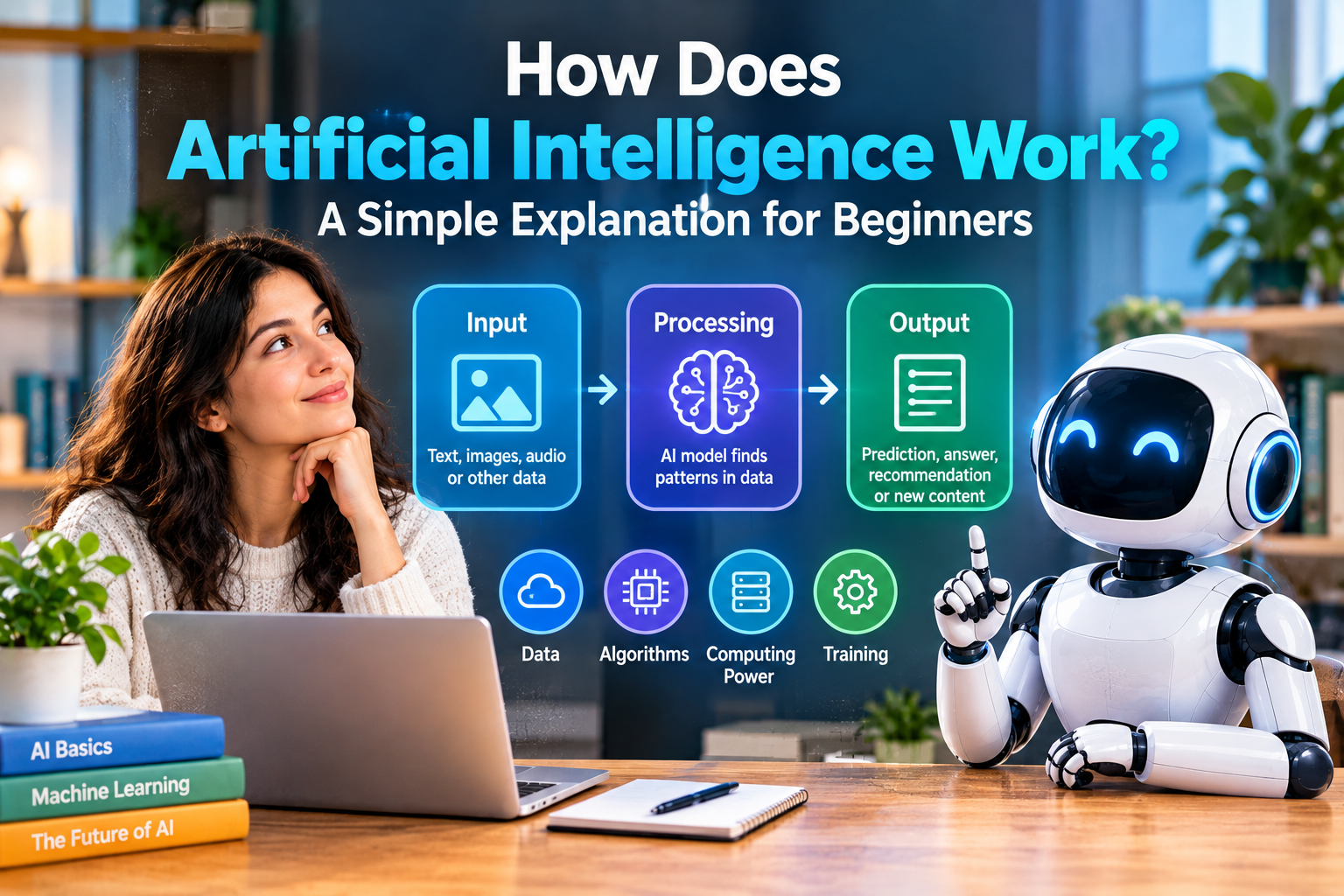
At its most basic level, an AI system receives information, processes it and produces an output.
For example, imagine you upload a photograph to an AI system and ask:
“What’s in this picture?”
The system processes the image and might respond:
“There is a dog sitting on a sofa.”
Another AI system might receive a sentence and translate it into another language.
A different system might look at financial transactions and identify one that appears unusual.
The tasks can be very different, but the general process is similar:
Input → Processing → Output
The complicated part is what happens in the middle.
Modern AI systems don’t simply follow a huge collection of fixed instructions. Many of them use models that have been trained to recognize patterns in data.
That’s where machine learning becomes important.
What Is Machine Learning?
Machine learning is one of the main technologies behind modern artificial intelligence.
Traditional computer programs generally work according to instructions written by programmers.
Imagine creating a simple program that determines whether a number is even or odd. A programmer can explicitly tell the computer what rule to follow.
But many real-world problems aren’t that straightforward.
Consider image recognition.
How would you write a list of instructions telling a computer exactly what a cat looks like?
You could describe its ears, eyes, nose, fur and body shape, but there are millions of variations. Cats can be large, small, fluffy, short-haired, sitting, lying down or partially hidden.
Instead of manually describing every possibility, machine learning allows a computer to learn patterns from examples.
The system can be given large numbers of images and information about what those images contain.
Over time, the model adjusts itself to become better at making predictions.
That’s one of the major differences between traditional programming and machine learning.
For a deeper look at the difference between these technologies, our upcoming guide Machine Learning vs. Artificial Intelligence: What’s the Difference? will explore how AI and machine learning relate to each other.
Data Is the Fuel for Many AI Systems
If you’ve ever heard someone say that “data is the fuel of AI,” there’s a reason for the comparison.
Many machine-learning systems depend heavily on data.
Data can include almost anything that can be represented digitally:
- Text
- Images
- Audio
- Video
- Numbers
- Sensor readings
- User interactions
- Documents
- Transactions
The type of data depends on what the AI system is being built to do.
A speech-recognition system needs audio and language data.
An image-recognition system needs images.
A recommendation system might use information about what people watch, read, buy or listen to.
A language model is trained using enormous amounts of text and other data sources appropriate to its development.
The model looks for patterns in that information.
The better the training process and the more useful and representative the data, the more capable the resulting system can become.
However, simply having a huge amount of data doesn’t automatically guarantee a good AI system.
The quality of the data matters too.
Poor-quality, inaccurate or biased data can create problems for an AI model.
What Is an AI Model?
The word “model” appears everywhere when people talk about artificial intelligence.
But what does it actually mean?
An AI model is essentially a trained computational system that has learned patterns from data and can use those patterns to perform a task.
Think of it as a very sophisticated pattern-recognition system.
Suppose you train a model using thousands of examples of houses and information about their prices.
The model might learn relationships between factors such as:
- Location
- Size
- Number of bedrooms
- Property type
- Age
- Other relevant characteristics
Once trained, the model can receive information about a new house and estimate its likely price.
It isn’t simply memorizing one answer.
It is using patterns learned during training to produce a prediction.
The same basic principle can be applied to countless other problems.
How Does AI Learn From Data?
The word “learn” can make AI sound more human than it really is.
An AI model doesn’t sit down and study a book in the same way a person does.
Instead, learning generally involves mathematics and optimization.
Here’s a simplified example.
Imagine an AI system is learning to identify whether an email is spam.
At the beginning, the model isn’t very good at the task.
It receives an email and makes a prediction.
Maybe it says:
“This is probably not spam.”
But the training data says that it actually is spam.
The system calculates how far its prediction was from the desired result.
A training process then adjusts the model’s internal parameters.
The model tries again.
This happens over and over, often across enormous amounts of data.
Eventually, the model may become much better at recognizing patterns associated with spam.
This process is far more complicated in real AI systems, but the underlying idea is relatively simple:
Make a prediction → measure the error → adjust the model → try again.
Repeat that process many times, and the model can improve.
What Are Parameters?
You may also hear AI experts talk about parameters.
Parameters are numerical values inside a machine-learning model that influence how the model processes information and makes predictions.
You don’t need to understand the mathematics behind every parameter to understand the basic concept.
Think of them as adjustable settings inside a very complicated mathematical system.
During training, these values are adjusted so the model becomes better at the task it is being trained to perform.
Large modern AI models can contain enormous numbers of parameters.
However, a larger number of parameters doesn’t automatically mean a model is better at everything. The architecture, training methods, data, computing resources and evaluation process all matter.
What Is Training?
Training is the process through which an AI model learns patterns from data.
For a simple machine-learning model, training might involve a relatively small dataset.
For modern large AI models, training can be vastly more complicated.
Powerful computing systems process huge quantities of information while the model’s parameters are repeatedly adjusted.
This can require enormous amounts of computing power.
Training can also take considerable time and resources.
Once a model has been trained, it can then be used for another stage known as inference.
What Is Inference?
Inference is what happens when a trained AI model is actually used to produce an output.
For example, when you type a question into an AI chatbot, the system doesn’t necessarily start its entire training process again.
Instead, the trained model processes your input and generates a response.
That’s inference.
A simple way to remember the difference is:
Training = learning patterns
Inference = using the learned patterns
The distinction is important because training and running a model can have very different technical and financial requirements.
How Do AI Chatbots Generate Answers?
This is one of the questions people ask most often.
Suppose you type:
“Why is the sky blue?”
into an AI chatbot.
The system processes your words and uses its trained model to determine what response is most appropriate.
Modern language models work with units of text commonly called tokens.
A token might represent a whole word, part of a word, punctuation or another piece of text, depending on the system.
The model processes the sequence of tokens and predicts what should come next based on patterns it learned during training.
It does this repeatedly to construct a response.
This is one reason language models can produce remarkably fluent text.
They have learned complex patterns involving vocabulary, grammar, sentence structure, concepts and relationships within their training process.
That doesn’t mean the system understands everything exactly as a human does.
It means the model has become extremely capable at processing and generating language.
Why Can AI Make Mistakes?
This is an important part of understanding how AI works.
People sometimes assume that because an AI system sounds confident, its answer must be correct.
That’s not necessarily true.
AI models can make mistakes for several reasons.
The model may not have enough information.
It may misunderstand the user’s question.
The training data may contain errors or limitations.
The model may generate an answer that sounds plausible even though the underlying information is incorrect.
Language models in particular can sometimes produce what researchers and developers commonly refer to as hallucinations—responses that appear convincing but contain false or unsupported information.
That’s why AI output should not automatically be treated as fact.
For everyday tasks, a small mistake might not matter much.
For medical, legal, financial or other high-stakes decisions, human expertise and reliable sources are especially important.
How Does AI Recognize Images?
AI can work with images in much the same broad way it works with text: by identifying patterns.
Imagine showing an AI system thousands of photographs containing cars.
During training, the model learns visual patterns associated with cars.
These patterns can involve shapes, edges, textures, colors and relationships between different parts of an image.
Modern computer-vision systems can perform much more sophisticated tasks than simply saying “car” or “not car.”
They can sometimes identify objects, describe scenes, detect unusual patterns, analyze documents and perform other image-related tasks.
Again, the important point is that the system isn’t looking at an image exactly as a human does.
It processes numerical representations of the information and uses learned patterns to make predictions.
How Does AI Understand Speech?
Speech recognition is another example of AI working with patterns.
When you speak into a smartphone, computer or voice assistant, the system receives an audio signal.
AI models can analyze characteristics of that signal and convert spoken language into text.
Modern speech systems can often handle different accents, speaking speeds, background noise and conversational language much better than older systems.
The result is the familiar experience of speaking naturally and seeing your words appear on a screen.
Voice technology has become so common that many people no longer think of it as an AI application.
How Do Recommendation Systems Work?
Have you ever watched one video and then noticed that a platform immediately recommended several similar ones?
Recommendation systems are another everyday application of AI and machine learning.
These systems can analyze patterns in user behavior.
For example, a platform might consider signals such as:
- What you watched
- How long you watched it
- What you searched for
- What you clicked
- What you skipped
- What similar users enjoyed
The system can then use these patterns to estimate what you might be interested in next.
This doesn’t mean the AI knows exactly what you’re thinking.
It’s making predictions based on available information.
Sometimes it gets those predictions surprisingly right.
Sometimes it gets them completely wrong.
Does AI Actually Understand What It Is Doing?
This is where things become philosophically interesting.
AI systems can perform tasks that appear to require understanding, but that doesn’t necessarily mean they possess human-like consciousness or awareness.
A language model can explain a complicated scientific concept.
An image model can identify objects.
A chess engine can defeat world-class players.
Yet none of these abilities, by themselves, prove that the system experiences the world like a human being.
Artificial intelligence should therefore not automatically be treated as a digital version of the human brain.
It is a different kind of technology with different strengths and limitations.
Why Are Modern AI Systems So Powerful?
Several developments have helped push AI forward.
More Computing Power
Modern hardware can perform enormous numbers of mathematical operations quickly.
More Data
The digital world produces huge amounts of text, images, video, audio and other information that can be used in AI development.
Better Algorithms
Researchers have developed increasingly effective approaches for training and using machine-learning models.
Larger Models
Some modern AI systems contain vastly more parameters and are trained using enormous computational resources.
Better Specialized Hardware
Graphics processors and other specialized hardware have become important for large-scale AI workloads.
These developments didn’t happen independently.
Together, they created an environment where increasingly capable AI systems became practical.
Does AI Learn After You Ask It a Question?
This depends on the specific AI system.
It’s a common misconception that every AI chatbot immediately changes its underlying model whenever someone sends it a message.
In many systems, a conversation is processed by an already-trained model.
Some AI products may have features that allow them to remember information, use conversation history, retrieve documents or improve through separate development and training processes.
But that’s different from saying that every individual question instantly retrains the underlying model.
The exact behavior depends on how a particular AI product has been designed.
What Makes Generative AI Different?
Traditional AI systems are often designed to classify, predict or recommend.
Generative AI can go a step further by producing new content.
A generative system can create:
- Articles
- Summaries
- Images
- Computer code
- Audio
- Video
- Presentations
- Other forms of content
Instead of simply saying whether something belongs to a particular category, the system can generate an output based on your instructions.
That’s one reason generative AI has become such a significant development.
It changes the way people interact with software.
Instead of clicking through dozens of menus, users can increasingly describe what they want in ordinary language.
Is AI Really Intelligent?
The answer depends on what we mean by “intelligent.”
AI can demonstrate impressive capabilities.
It can recognize patterns across huge datasets, generate language, solve certain mathematical problems, write code, analyze images and perform many other tasks.
But AI intelligence isn’t identical to human intelligence.
Humans learn through physical experience, emotions, social relationships, observation and countless other forms of interaction with the world.
AI systems operate through computational processes and learned patterns.
So rather than asking whether AI is exactly as intelligent as a human, it may be more useful to ask:
What kinds of problems is this particular AI system good at?
That question gives us a much more realistic picture of the technology.
What Does the Future of AI Look Like?
AI is likely to become increasingly integrated into software, workplaces and everyday products.
We may see AI assistants helping people organize information, analyze documents, write software, learn new subjects and complete routine tasks.
Businesses may use AI to automate repetitive processes and make better use of large datasets.
Researchers may continue using AI in areas such as scientific discovery, engineering and medicine.
At the same time, questions about privacy, misinformation, employment, copyright, security and responsible development will become increasingly important.
The technology may become more powerful, but that doesn’t remove the need for human judgment.
If anything, it makes good judgment more valuable.
Final Thoughts
Artificial intelligence may seem mysterious when you only see the finished result.
You type a question, and an answer appears.
You upload an image, and the system describes it.
You speak into your phone, and your words become text.
But underneath these experiences are mathematical models trained on data and running on powerful computing systems.
At the heart of many modern AI systems is a surprisingly simple idea:
Learn patterns from data and use those patterns to make predictions or generate useful outputs.
The technology built around that idea can be extraordinarily sophisticated, but understanding the basic principles makes AI much less mysterious.
And as AI becomes a bigger part of everyday life, understanding how it works isn’t just useful for technology professionals.
It’s becoming useful for everyone.
If you haven’t already, read What Is Artificial Intelligence? A Simple Guide for Beginners for a broader introduction to AI before exploring more advanced topics.
Frequently Asked Questions
How does artificial intelligence work in simple terms?
AI systems process information using models that have been trained to recognize patterns. The system takes an input, processes it using what it has learned and produces an output such as a prediction, recommendation, classification or generated response.
How does AI learn?
Many AI systems learn by analyzing large amounts of data during training. The model makes predictions, measures errors and adjusts its internal parameters repeatedly until its performance improves.
What is machine learning in AI?
Machine learning is a method that allows computer systems to learn patterns from data rather than relying entirely on explicitly programmed instructions.
What is an AI model?
An AI model is a trained computational system that can use patterns learned from data to perform tasks such as making predictions, recognizing information or generating content.
Can AI learn from every question I ask?
Not necessarily. Whether an AI system remembers information or uses conversations to improve depends on how that particular product has been designed. A user’s question does not automatically mean the underlying model is immediately retrained.
Why does AI sometimes give wrong answers?
AI systems can make mistakes because of limitations in their training data, the model itself, the information available to it or the way a question is interpreted. Some generative AI systems can also produce plausible-sounding but incorrect information.
Is artificial intelligence the same as machine learning?
No. Machine learning is one major approach used within artificial intelligence. AI is the broader field, while machine learning focuses on systems that learn patterns from data.