
Artificial intelligence, usually called AI, has gone from being something we mostly saw in science-fiction movies to something many of us use every day.
You may have used AI today without even thinking about it. Maybe your phone suggested the next word while you were typing a message. Perhaps YouTube recommended a video you ended up watching, your email filtered out a suspicious message, or a shopping website suggested a product that caught your attention.
None of these things feel particularly futuristic anymore. They are simply part of modern life.
But what exactly is artificial intelligence? How does it work? And when people talk about AI “learning,” what does that actually mean?
Let’s break it down without getting buried in complicated technical language.
What Is Artificial Intelligence?
Artificial intelligence is a branch of technology that focuses on creating computer systems capable of performing tasks that normally require some form of human intelligence.
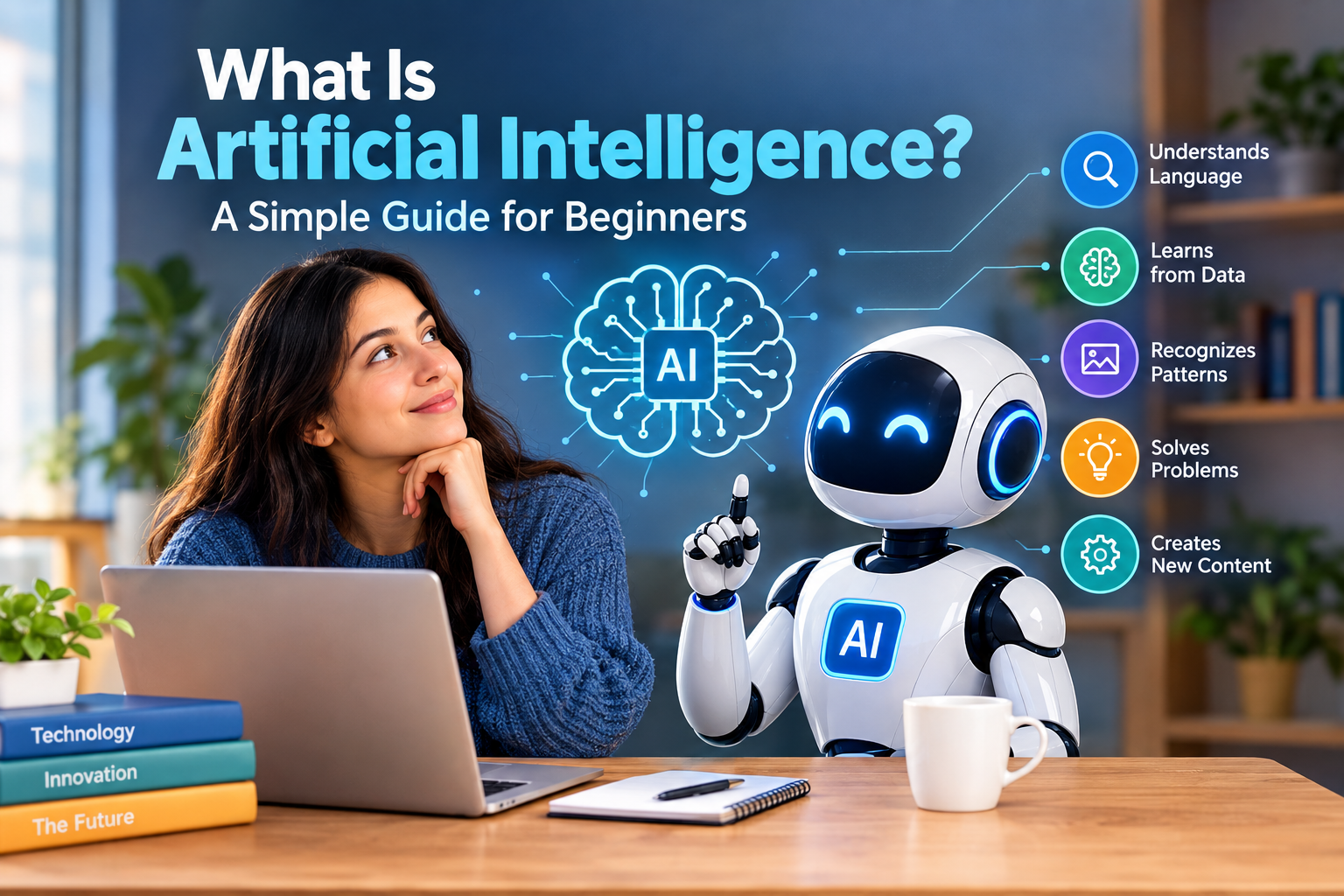
These tasks can include understanding language, recognizing images, identifying patterns, making predictions, solving problems, and generating content.
The important word here is tasks.
AI isn’t necessarily a machine that thinks exactly like a human. In fact, most AI systems today are very different from human intelligence. Instead, they are designed to become very good at particular types of problems.
For example, an AI system can be trained to recognize whether an image contains a cat. Another can translate text from one language to another. A different system can analyze thousands of financial transactions and identify patterns that might indicate fraud.
Modern AI can even generate essays, computer code, images, music and videos.
That’s one reason artificial intelligence has attracted so much attention in recent years.
How Does AI Actually Work?
At its simplest, an AI system takes information as an input, processes it using a model, and produces an output.
Imagine showing a computer thousands or millions of examples of handwritten numbers.
A person can look at a handwritten “7” and recognize it almost instantly. A computer doesn’t naturally understand what a seven looks like. It has to learn patterns from examples.
During training, an AI model examines many examples and gradually adjusts its internal parameters so that its predictions become more accurate.
Over time, it may learn that certain combinations of lines, curves and shapes are commonly associated with particular numbers.
The same basic idea can be used for much more complicated tasks.
An AI model trained on large amounts of text can learn patterns in language. A model trained on images can learn visual patterns. A model trained on audio can learn characteristics of speech and other sounds.
This is one of the foundations of modern machine learning.
What Is Machine Learning?
Machine learning is one of the most important areas of artificial intelligence.
Instead of giving a computer an enormous list of instructions for every possible situation, developers can train a machine-learning model using data.
Think about teaching someone to recognize different breeds of dogs.
You could try to write down every characteristic of every breed: the shape of the ears, length of the fur, size, color and so on.
But there’s another approach. You could show the person thousands of photographs and tell them what breed each photograph represents.
After seeing enough examples, they may begin to recognize patterns for themselves.
Machine learning works in a somewhat similar way.
A model analyzes data, finds patterns within that data and uses those patterns to make predictions or decisions about new information.
This doesn’t mean the computer understands the world in exactly the same way a person does. It means the system has learned statistical patterns that can be useful for a particular task.
What Is Generative AI?
You’ve probably heard another term frequently mentioned alongside AI: generative AI.
Generative AI refers to systems that can create new content based on patterns learned from existing data.
That content might be:
- Text
- Images
- Music
- Computer code
- Voice
- Video
Chatbots are one of the most visible examples.
You can give a generative AI system a question or instruction, and it can produce a response based on patterns learned during training.
Image-generation systems work in a similar broad sense. Instead of generating words, they produce images based on a user’s description.
This has opened up a completely different way of interacting with computers.
For decades, using software generally meant learning how its menus, buttons and commands worked. Generative AI has introduced another possibility: simply telling the software what you want in ordinary language.
How Does AI Learn?
The word “learn” can be slightly misleading.
When humans learn something, we usually develop an understanding that can involve memory, experience, reasoning, emotions and physical interaction with the world.
AI learning is different.
A machine-learning model generally learns by adjusting numerical parameters during a training process.
For example, suppose an AI model is being trained to recognize spam emails.
It may be given a huge collection of emails, some labeled as spam and others as legitimate.
The model looks for patterns. Perhaps certain words, links, formatting choices or combinations of characteristics appear more frequently in spam messages.
When the model makes a mistake, the training process adjusts its parameters.
After repeating this process many times, the model can become quite good at identifying patterns associated with spam.
That is why data is so important to modern AI.
The quality, quantity and diversity of training data can have a major impact on what a model is capable of doing.
Where Do We Use Artificial Intelligence?
AI is already present in many areas of everyday life.
Search Engines
Search engines use sophisticated algorithms and machine-learning systems to understand queries and determine which results are likely to be useful.
Streaming Services
Services that recommend movies, shows or music can analyze patterns in what people watch or listen to and use those patterns to suggest additional content.
Online Shopping
E-commerce platforms use AI to recommend products, detect suspicious activity, predict demand and personalize parts of the shopping experience.
Smartphones
Modern phones use machine learning for things such as speech recognition, photography features, translation, keyboard predictions and security.
Healthcare
AI is increasingly being researched and used for medical imaging, data analysis, drug discovery and other healthcare applications. In these areas, however, accuracy and human oversight are particularly important.
Banking
Banks and financial institutions use automated systems to detect unusual transactions and identify potential fraud.
Customer Service
Many companies now use AI-powered chatbots to answer common questions, summarize information and help customers find the right resources.
So although AI may sometimes seem like a new technology, the underlying techniques have been developing for decades.
Is AI the Same as a Human Brain?
No.
This is one of the most common misconceptions about artificial intelligence.
AI systems can perform certain tasks extremely well, but that doesn’t mean they possess human-like understanding or consciousness.
A language model can generate an impressive explanation of a topic without experiencing the world in the way a human does.
An image-recognition model can identify objects without having human visual awareness.
A chess-playing system can defeat some of the world’s strongest players without understanding chess in the same way a human grandmaster does.
AI can be extraordinarily capable while still being fundamentally different from human intelligence.
What Are the Benefits of AI?
One reason businesses and individuals are investing heavily in AI is that it can provide some significant advantages.
It Can Process Huge Amounts of Information
A computer can analyze enormous datasets much faster than a person could manually.
It Can Automate Repetitive Work
Tasks that are predictable and repetitive can often be automated, allowing people to spend more time on work that requires judgment, creativity or communication.
It Can Help People Make Decisions
AI can identify patterns in data that might otherwise be difficult to notice.
It Can Improve Accessibility
Speech recognition, translation, image descriptions and other AI-powered technologies can make digital tools easier to use for people with different needs.
It Can Help People Create
Generative AI gives individuals access to tools that can assist with writing, brainstorming, coding, design and other creative tasks.
These benefits don’t mean AI should automatically be used for everything. There are situations where human judgment remains essential.
What Are the Risks of Artificial Intelligence?
AI also comes with real challenges.
One concern is accuracy.
AI systems can make mistakes. Some generative AI systems can confidently produce information that sounds convincing but isn’t correct.
Another concern is bias.
If the data used to train a system contains problematic patterns or represents some groups poorly, the resulting system may reproduce those problems.
There are also questions about privacy, copyright, cybersecurity, misinformation and the impact of automation on employment.
These issues are not reasons to reject AI altogether. They are reasons to develop and use it carefully.
The more powerful the technology becomes, the more important responsible use becomes.
Will AI Replace Humans?
This question comes up almost every time artificial intelligence is discussed.
The honest answer is more complicated than a simple yes or no.
AI is likely to automate some tasks that people currently perform. It may also change the responsibilities associated with many jobs.
But jobs are made up of collections of tasks, and not every task within a job is equally easy to automate.
For example, an AI system might help a writer research ideas, summarize information or create an initial draft. That doesn’t necessarily mean a human writer becomes unnecessary.
The same principle applies to many other professions.
In many cases, the future may be less about humans versus AI and more about humans working with AI.
People who understand how to use these tools effectively may gain an advantage over those who ignore them completely.
Why Is AI Becoming So Popular Now?
Artificial intelligence isn’t new. Researchers have been working on it for many decades.
So why does it suddenly feel like AI is everywhere?
Several things came together.
Computers became much more powerful. Huge amounts of digital data became available. Machine-learning techniques improved. Specialized hardware made it possible to train increasingly large models.
Then generative AI made these technologies accessible to ordinary people.
Instead of needing technical knowledge to interact with an AI system, people could simply type a question into a chat box.
That changed the experience dramatically.
AI stopped feeling like something that existed only inside research laboratories and became something people could experiment with themselves.
What Does the Future of AI Look Like?
Nobody can predict exactly what artificial intelligence will look like ten or twenty years from now.
What we can say is that AI is likely to continue becoming part of more areas of work and everyday life.
Some applications will probably disappear or change as better technologies arrive. Others will become so normal that we eventually stop thinking of them as “AI.”
That’s already happened with many technologies.
The interesting question isn’t simply whether AI will become more powerful.
It’s how people, businesses, schools and governments will choose to use that power.
Technology itself doesn’t decide whether a particular application is beneficial or harmful. Human choices matter.
Final Thoughts
Artificial intelligence can seem complicated because it covers such a huge range of technologies.
But the basic idea is easier to understand than it first appears.
AI allows computers to perform tasks that traditionally required forms of human intelligence. Modern machine-learning systems learn patterns from data, while generative AI can use learned patterns to produce new content.
And despite all the headlines, AI is not some distant technology waiting for the future.
It’s already here.
The more useful question now is not simply, “What is AI?”
It’s “What can we do with it, and how should we use it responsibly?”
That is a conversation that is likely to become even more important as artificial intelligence continues to evolve.
Frequently Asked Questions
Is artificial intelligence difficult to learn?
The technical side of AI can be very complex, but understanding the basic concepts doesn’t require a programming background. Beginners can start with concepts such as machine learning, data, models and generative AI.
Is ChatGPT artificial intelligence?
Yes. ChatGPT is an example of a generative AI system based on large language models. It can process natural-language prompts and generate responses based on patterns learned during training.
Can AI think like humans?
Not in the same way humans do. AI systems can perform sophisticated tasks, but their underlying mechanisms are fundamentally different from human thought and experience.
Will artificial intelligence replace all jobs?
There is no reliable basis for saying that AI will replace all jobs. It is more likely that AI will automate some tasks, change many occupations and create new types of work while increasing the importance of some human skills.
Why is data important for AI?
Many modern AI systems learn patterns from data. The information used during training helps a model learn how to make predictions, recognize patterns or generate content.
Is AI always accurate?
No. AI systems can make mistakes, misunderstand information or produce incorrect answers. Important decisions should not rely on AI output without appropriate human review.
[…] Does Artificial Intelligence Work? A Simple Explanation for Beginners What Is Artificial Intelligence? A Simple Guide for Beginners PlayStation Network Outage: What Gamers Need to Know Super Bowl 2025: Predictions, Picks, and […]