
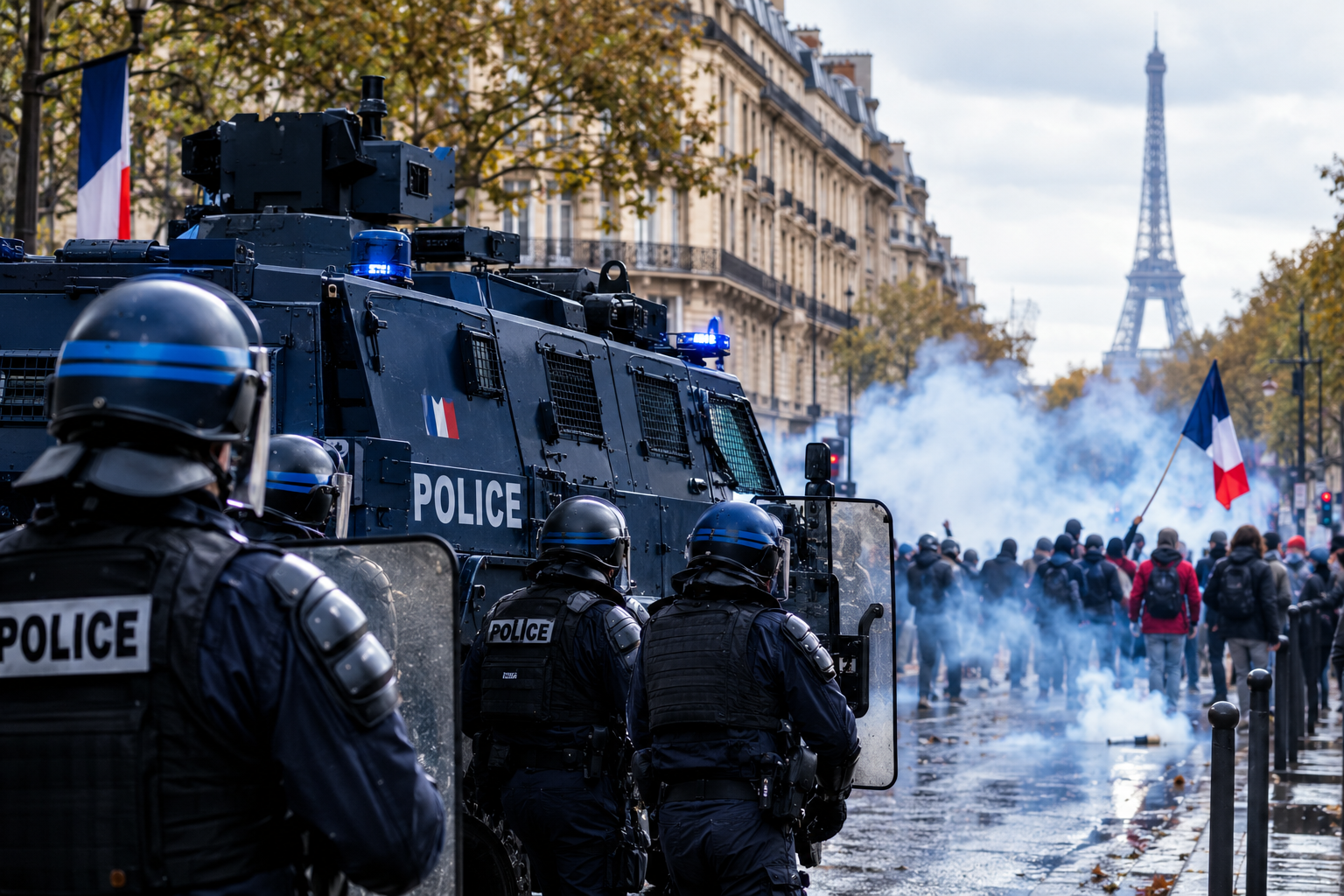
France faced another tense day of demonstrations on Saturday, October 24, as thousands of students, workers and other protesters took to the streets over the rising cost of living, education concerns and wider dissatisfaction with the government.
Authorities responded with a major security operation across the country. Around 70,000 security personnel were mobilised nationwide as the government sought to prevent a repeat of the violence, looting and property damage that occurred on the margins of demonstrations the previous weekend. Police deployed armoured vehicles and riot-control units in several cities, while authorities imposed restrictions on demonstrations and curfews in areas considered vulnerable to further unrest.
The situation was particularly tense in Lyon, where police fired tear gas to disperse approximately 150 protesters near Jean Moulin Lyon 3 University. The gathering took place close to an area where demonstrations had been prohibited, and AFP reported that officers intervened after protesters attempted to block a road. Armoured vehicles and riot police vans were also positioned nearby as authorities maintained a heavy security presence in the city.
In Marseille, authorities also deployed armoured vehicles, riot police vans and a water cannon. The city had imposed restrictions on demonstrations, although a union-organised march was allowed on an exceptional basis.
Meanwhile, in Grenoble, a separate incident demonstrated the dangers of attempts to disrupt major roads. According to the Isère prefecture, a group of about 20 masked individuals attempted to block the A480 motorway using rubbish bins. Their actions resulted in a collision between two vehicles, leaving two people with minor injuries. Police subsequently dispersed the group.
The developments underline the growing challenge facing French authorities: maintaining public order while allowing citizens to exercise their right to peaceful protest.
Why France is experiencing renewed protests
The latest demonstrations did not appear suddenly.
The movement began with student concerns about conditions in schools and has since expanded into a wider protest movement focused on the cost of living and dissatisfaction with government policies.
According to AFP, demonstrations that began among high school students over learning conditions spread nationally as broader economic grievances gained momentum. Rising prices have added to the frustration, bringing students, workers and other groups into the demonstrations.
This combination of economic and educational concerns is important for understanding the protests.
For students, the issue is not simply politics in the traditional sense. Conditions inside schools and universities can have a direct effect on their everyday lives. Concerns about classrooms, staffing, access to higher education and financial pressures can turn what initially appears to be a student-specific movement into a broader debate about the direction of government policy.
For workers and families, meanwhile, rising household costs can make economic issues more urgent.
When different groups begin expressing dissatisfaction at the same time, a protest movement can quickly become larger than the issue that originally triggered it.
That appears to be what has happened in France.
The shadow of last weekend’s violence
The unusually large police presence this weekend is largely explained by what happened during the previous round of demonstrations.
Last weekend’s protests were accompanied by serious violence in several cities. According to AFP, rioters operating on the margins of demonstrations clashed with police, vandalised public buildings and looted shops. Thousands of people were arrested, and hundreds of businesses were damaged or looted.
The government was therefore determined not to allow a repeat.
Approximately 70,000 security personnel were mobilised across France for the latest demonstrations, an increase from the previous weekend’s deployment. Authorities wanted police to be positioned in advance at locations where they expected trouble rather than simply responding after violence had already begun.
That strategy was visible in cities across the country.
Armoured vehicles were positioned in Lyon and Marseille, police patrols were increased and shops in some areas were boarded up in anticipation of possible disorder.
The measures show how seriously officials are treating the latest demonstrations.
Lyon becomes an early flashpoint
Lyon was among the first major cities where police confronted protesters on Saturday.
About 150 people gathered near Jean Moulin Lyon 3 University, according to AFP reporting. The gathering was close to an area where authorities had prohibited demonstrations.
Police eventually used tear gas to disperse the group after protesters attempted to block a road.
The incident is significant because universities and schools have played an important role in the current protest movement.
Student demonstrations can develop rapidly because young people are able to communicate through social media and campus networks. A gathering that begins with a relatively small number of participants can quickly attract additional people.
At the same time, authorities are particularly concerned when demonstrations move into restricted areas.
The French government has argued that restrictions are necessary because of the violence that accompanied some of the previous demonstrations. Critics, however, have warned that broad protest bans can interfere with the right to peaceful assembly.
This disagreement is now an important part of the political debate surrounding the protests.
Why tear gas was used
Tear gas is one of the crowd-control methods available to police when officers are attempting to disperse a gathering.
Its use in Lyon demonstrates the difficult conditions facing police.
Officers must determine when a gathering has crossed from a peaceful demonstration into a situation that authorities consider unlawful or dangerous. Once an area has been placed under a protest ban, police may be instructed to disperse people who gather there.
However, the use of force can itself become controversial.
Protesters may argue that they were exercising their right to demonstrate, while authorities may argue that the gathering was taking place in a prohibited area or was creating a danger to public safety.
That difference in interpretation can make demonstrations particularly difficult to manage.
The Lyon incident also shows why the location of a protest matters.
A gathering near a university or police station may attract a different response from authorities than a demonstration taking place on an approved route.
Armoured vehicles appear in Marseille
Marseille also saw a substantial police presence.
AFP journalists reported numerous riot police vans, armoured vehicles and a water cannon in the city. The deployment came as authorities attempted to prevent renewed violence following the previous weekend’s unrest.
The presence of armoured vehicles does not necessarily mean that violence has already occurred.
Such vehicles can be deployed as a precaution, providing police with protected transport and allowing security forces to respond quickly if a situation deteriorates.
In Marseille, authorities had initially prohibited protests but later allowed a union-organised demonstration to proceed on an exceptional basis.
This illustrates the complicated approach being taken across France.
The government is not simply banning every demonstration.
Instead, authorities are attempting to distinguish between organised demonstrations that can be managed and gatherings they believe could create a serious risk of disorder.
That distinction has nevertheless generated criticism from civil liberties organisations.
Paris prepares for another difficult day
Paris remains at the centre of the national political debate.
The capital is home to the country’s principal government institutions and attracts enormous numbers of demonstrators during major political movements.
Ahead of Saturday’s protests, many shops in central Paris boarded up their windows. Some businesses removed merchandise, while major museums including the Louvre and Musée d’Orsay were closed as a precaution.
The decision to restrict parts of the capital also affected the route of an organised demonstration.
Authorities changed the route of a union-backed march, moving it away from the Bastille–Nation route toward a route between Porte d’Italie and Porte de Vincennes.
The dispute over the route eventually reached the administrative courts, which allowed the authorities’ revised route to stand.
The issue is important because the location of a demonstration can influence both its political visibility and its potential impact on public safety.
A march through central Paris can attract enormous attention, but it can also cause greater disruption to transport, businesses and surrounding neighbourhoods.
Grenoble and the dangers of motorway blockades
The incident in Grenoble provides another example of the difficult line between protest and public safety.
A group of about 20 masked individuals attempted to obstruct traffic on the A480 near the Catane bridge by placing rubbish bins on the road, according to the Isère prefecture. The obstruction led to a collision between two vehicles and two people suffered minor injuries. Police quickly intervened and dispersed the group.
The incident demonstrates why authorities react strongly to attempts to block major roads.
Motorways are fundamentally different from ordinary public spaces.
Drivers travel at high speeds and may have only seconds to respond to an unexpected obstacle. A sudden blockage can therefore create a serious risk even when protesters do not intend to harm anyone.
The Grenoble authorities condemned the action and warned that obstructing traffic can put other road users in danger.
From the perspective of protesters, road blockades can be an effective way of attracting attention and demonstrating the seriousness of their demands.
But the tactic can also alienate members of the public who become trapped in traffic or face safety risks.
That tension is common in protest movements around the world.
Curfews add another layer to the response
Alongside protest restrictions, French authorities have introduced curfews in several areas.
The measures come amid concern that unrest could continue after dark and that young people could become involved in disturbances.
AFP reported that partial curfews had already been introduced in Paris and other cities following the violence of the previous weekend.
Grenoble also introduced a curfew covering several parts of the metropolitan area from Saturday evening into Sunday morning. The measure followed concerns about possible disorder and was accompanied by increased police and gendarmerie deployments.
Curfews are a powerful public-order measure because they restrict people’s ability to remain in designated public areas during certain hours.
Supporters argue that such restrictions can prevent groups from gathering at night when police resources are stretched and visibility is reduced.
Critics, however, question whether broad restrictions are proportionate, particularly when they affect people who are not involved in protests.
This debate is likely to continue as the government attempts to balance security concerns with civil liberties.
Protest rights versus public order
One of the most important questions raised by the latest events is how democratic societies should respond when large demonstrations become associated with violence.
France has a long tradition of public protest.
Street demonstrations, strikes and student movements have played major roles in the country’s political history. Protesting government policy is therefore not unusual in France.
The challenge arises when peaceful demonstrations are accompanied by vandalism, looting, attacks on police or dangerous attempts to block major roads.
The government has attempted to draw a distinction between protesters making legitimate demands and people engaging in criminal behaviour.
President Emmanuel Macron and government officials have called for firm action against violence while maintaining that legitimate demonstrations should be separated from criminal activity.
Civil liberties groups have expressed concern that some of the restrictions introduced in response to the unrest could go too far.
Le Monde reported that protest bans and curfews across France have prompted concerns about the rule of law, while rights organisations have questioned whether restrictions are proportionate.
This creates a difficult balance.
Police have a responsibility to protect people and property.
Protesters have a right to express political opinions.
Businesses have a right to operate without being targeted.
Drivers have a right to use major roads safely.
Finding a way to protect all of these interests at the same time is extremely difficult during periods of national unrest.
Why students are central to the movement
Students have become one of the most visible groups in the current demonstrations.
The movement began partly with concerns about educational conditions, but student demands have expanded as the wider cost-of-living crisis has become part of the debate.
Students face their own economic pressures.
Housing, transportation, food and education costs can create significant financial difficulties, particularly in large cities.
At the same time, young people are directly affected by decisions involving schools and universities.
That helps explain why student groups have been willing to continue demonstrating even after authorities introduced restrictions.
AFP reported that President Macron met representatives of secondary school students, but student representatives continued to urge further protest until they received concrete proposals addressing their concerns.
The government’s challenge is therefore not simply to restore order.
It must also decide how to respond to the underlying demands that brought people onto the streets in the first place.
The economic dimension
The cost of living is another major factor behind the demonstrations.
When household expenses increase faster than incomes, people can become frustrated with governments regardless of their political background.
The current protests have therefore attracted people with different interests.
Some participants are focused primarily on education.
Others are concerned about wages, prices or public services.
Still others are protesting against the political direction of the government.
When these grievances come together, it becomes harder for authorities to resolve the unrest through a single policy announcement.
The government can address one demand while leaving several others unanswered.
That is why the protests could continue even after police restore order on the streets.
The effect on businesses
The unrest is also having an economic impact on businesses.
Shopkeepers in several cities have boarded up their storefronts in anticipation of demonstrations.
AFP reported that businesses in Paris, Bordeaux, Rennes and other cities were taking precautions, while some retailers closed temporarily.
For small businesses, even a single day of closure can be costly.
Businesses may lose sales, pay employees despite reduced activity and spend money repairing or protecting their premises.
One Paris shopkeeper told AFP that the protest route raised concerns because of its narrow streets and proximity to sensitive infrastructure.
This demonstrates that the consequences of demonstrations extend beyond the protesters and police.
Ordinary workers, shop owners, commuters and residents can all be affected.
The role of social media
Social media has also become an important part of the protests.
Calls to attend demonstrations or defy restrictions can spread quickly online.
Authorities have expressed concern about messages encouraging violence and looting, while protesters use social media to coordinate gatherings and communicate their views.
The speed of online communication creates a challenge for police.
A gathering can move from one location to another within minutes.
Rumours can also spread rapidly, making it difficult for people to distinguish verified information from speculation.
This is why official announcements and reliable journalism are particularly important during periods of unrest.
Readers should be cautious about relying exclusively on social media posts when trying to understand a developing protest.
France’s political climate
The demonstrations are taking place at a particularly sensitive political moment.
France is approaching another presidential election, and the unrest has become part of a wider political debate about the direction of the country.
AFP reported that the National Rally, led by Marine Le Pen, was holding a congress in Orléans during the weekend, while opposition demonstrations were also taking place.
This means the protests are not occurring in isolation from national politics.
Different political groups are attempting to interpret the unrest according to their own agendas.
The government has focused heavily on public order and the distinction between peaceful protest and criminal violence.
Opposition groups have highlighted economic dissatisfaction and concerns about government policy.
Civil liberties organisations have focused on protest rights and restrictions.
The same events can therefore be interpreted in very different ways depending on political perspective.
What the protests mean for France
The current situation provides an important lesson about the relationship between government, citizens and public institutions.
A democratic government must be able to maintain public safety.
At the same time, citizens must have meaningful opportunities to express disagreement.
When these two principles come into conflict, governments face difficult decisions.
If authorities allow unrestricted demonstrations regardless of circumstances, serious violence can occur.
If authorities impose excessive restrictions, citizens may feel that their democratic rights are being undermined.
The events in Lyon, Marseille, Paris and Grenoble demonstrate different aspects of this challenge.
In Lyon, police dispersed a gathering in an area where demonstrations had been prohibited. Marseille authorities, meanwhile, combined a heavy security presence with an exceptional decision to allow an organised union demonstration. Officials in Paris modified the route of an authorised march, while police in Grenoble intervened after an attempted motorway blockade resulted in a collision.
These situations are different, and treating them all as identical would oversimplify what is happening.
What could happen next?
The immediate objective for French authorities is to prevent another wave of violence.
Police will continue monitoring demonstrations and sensitive areas.
Authorities are likely to maintain restrictions where they believe there is a significant risk of disorder, while allowing organised demonstrations where security conditions permit.
The government will also face pressure to address the grievances driving the protests.
Security measures can disperse a crowd, but they cannot by themselves resolve dissatisfaction over education, living costs or political decisions.
That means the longer-term response will probably need to involve both public-order measures and political dialogue.
The events of October 24 may therefore become an important moment in the wider protest movement.
If demonstrations remain largely peaceful, the government could face increasing pressure to negotiate with student groups, unions and other organisers.
If serious violence returns, officials are likely to face demands for even stronger restrictions.
A difficult balance for French authorities
France’s latest protests demonstrate how quickly a movement focused on economic and educational concerns can become a wider national political crisis.
The deployment of armoured vehicles, the presence of tens of thousands of security personnel, protest restrictions and curfews all demonstrate the seriousness of the situation.
Yet the government’s response cannot be measured only by the number of police deployed.
The more important question is whether authorities can restore public safety while preserving the right to peaceful political expression.
The answer will depend partly on the behaviour of protesters.
Peaceful demonstrations can give citizens an opportunity to make their demands visible and put pressure on elected officials.
Violence, looting and dangerous road blockades, on the other hand, can weaken public support for a protest movement and give authorities stronger justification for restrictions.
The government also has responsibilities.
Police must distinguish as carefully as possible between peaceful protesters and people involved in violence.
Restrictions should be clearly explained and applied according to the law.
Authorities must also address the underlying concerns that have brought students and other citizens into the streets.
Conclusion
France is facing a significant period of public unrest as demonstrations over living costs, education and government policy continue across the country.
The latest events show how varied the situation has become.
In Lyon, police used tear gas to disperse around 150 protesters near Jean Moulin Lyon 3 University after an attempt to block a road. In Marseille, armoured vehicles, riot police vans and water cannon formed part of a substantial security operation. Paris saw extensive preparations, business closures and changes to authorised protest routes. In Grenoble, an attempted A480 motorway blockade resulted in a vehicle collision that left two people with minor injuries.
These developments are not simply a story about police and protesters.
They are also about the economic pressures facing households, the concerns of students, the responsibilities of government and the limits of public protest.
For France, the challenge now is to prevent violence without allowing the political grievances behind the demonstrations to disappear from public discussion.
The coming days will show whether the country can move from confrontation toward dialogue.
For students and readers following international current affairs, the French protests provide an important example of how economic pressures, education concerns, political dissatisfaction and public-order challenges can come together and create a national crisis.
The situation also demonstrates why reliable information matters during rapidly developing events. Figures, locations and official measures can change from hour to hour, while social media can spread unverified claims quickly.
For that reason, readers should continue to follow updates from credible news organisations, government authorities and independent rights groups as the situation develops.
France’s latest protests remain a developing story, but one point is already clear: restoring calm will require more than police vehicles and curfews. It will require authorities and protesters alike to find a way to protect public safety while keeping space open for legitimate democratic debate.
Sources and Further Reading
- Agence France-Presse (AFP), October 24, 2026 — “Seen and heard at France protests”: On-the-ground reporting from Lyon, Marseille, Paris and other French cities, including the Lyon tear-gas dispersal and the deployment of armoured vehicles. Read the AFP report
- Agence France-Presse (AFP), October 24, 2026 — “Police fire tear gas as new French demonstrations kick off”: Coverage of the nationwide demonstrations, 70,000 security personnel and the security situation in major cities. Read the AFP report
- Agence France-Presse (AFP), October 24, 2026 — “Security high as France braces for new protests”: Background on the security preparations, protest restrictions and wider unrest. Read the AFP report
- Agence France-Presse (AFP), October 23, 2026 — “France to deploy 70,000 police as students urge further protests”: Background on the student movement and the government’s response. Read the AFP report
- Agence France-Presse (AFP), October 19, 2026 — “France announces curfews as government grapples with unrest”: Background on the earlier unrest and curfew measures. Read the AFP report
- Le Monde, October 23, 2026 — “France bans protests and imposes curfews in dozens of cities”: Background on protest bans, curfews and concerns surrounding freedom of assembly. Read the Le Monde report
- Isère prefecture reporting, reproduced by Anadolu Agency, October 24, 2026 — Details concerning the attempted A480 blockade and the two people who suffered minor injuries. Read the report